The short answer
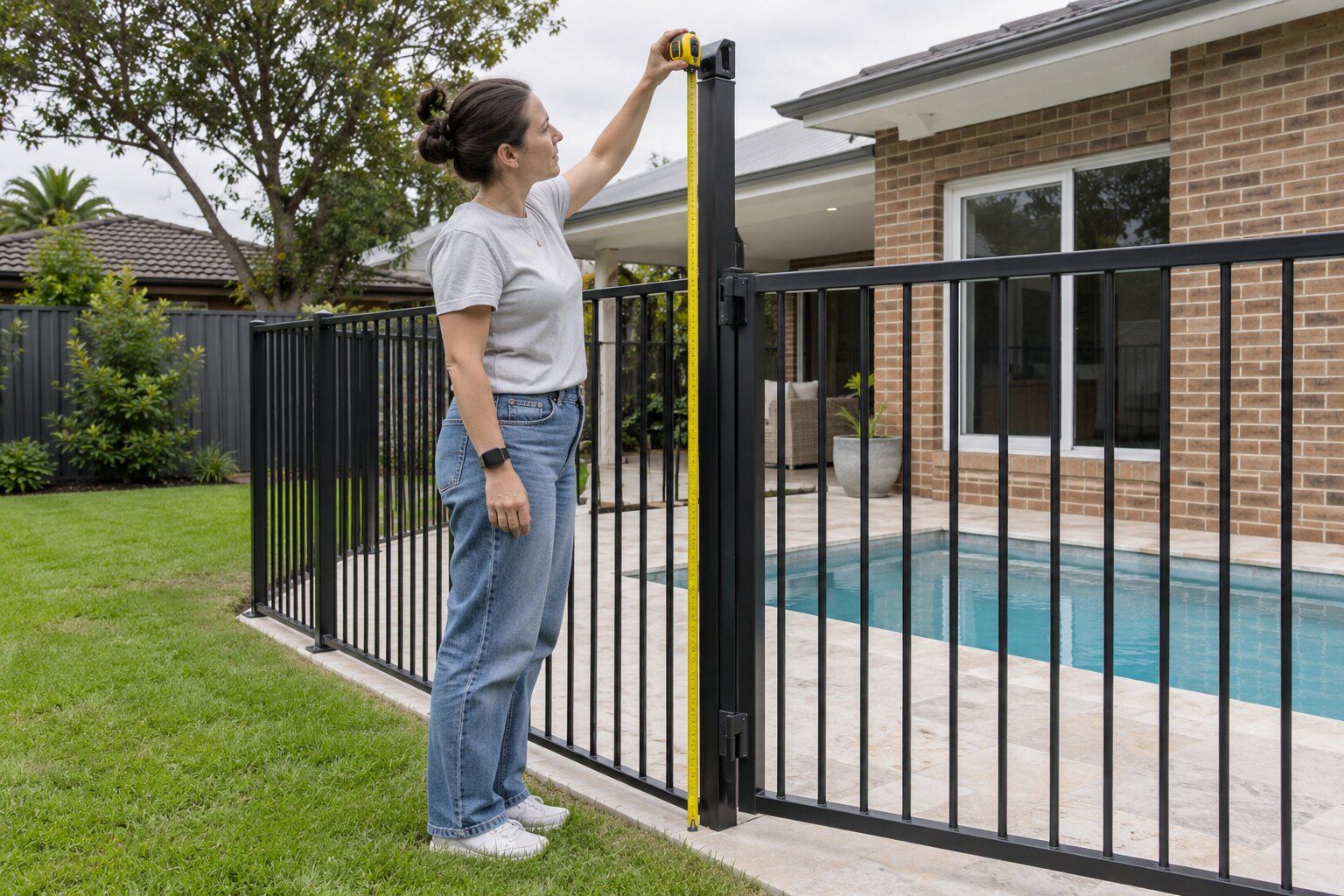
In NSW a pool gate must open outwards, away from the pool, shut and latch by itself from any open position, and be kept closed whenever it isn't in use. The NSW Swimming Pool Register checklist for pools built after 1 May 2013 puts the latch release 1500 mm above the ground; the Australian Standard allows other arrangements, such as a shielded latch on the pool side, and a certifier decides. No NSW rule sets a separate gate height or width. The gate sits in the barrier, so expect a certifier to check it against the barrier's 1.2 m height and 10 cm gaps.
Which way a pool gate must open in NSW
Outwards, away from the pool. The NSW Government's guide for pool owners says to check that the gate "swings outwards (away from the pool area)", and the NSW Swimming Pool Register's self-assessment checklists say "The gate must open outwards, away from the pool".
A gate that swings into the pool area has to be re-hung so it opens the other way.
Self-closing and self-latching from any position
The NSW Government's checklist says the gate "shuts automatically from any open position, without having to forcibly close it" and "automatically locks (self-latches) when it closes". The register checklists add that once closed it "can't be pulled open".
The law behind it is section 16 of the Swimming Pools Act 1992: gates giving access to the pool must be "kept securely closed at all times when they are not in actual use". So the gate can't be propped, tied or wedged open, even while people are in the pool.
"Any open position" means fully open, halfway and just off the latch. The pool gate not closing guide shows how to test each position and adjust the hinges.
Pool gate latch height in NSW
The register's self-assessment checklists, which councils still publish, give two ways to keep the latch release out of a child's reach:
- Outside the gate: "The release for the gate latch must be 1500mm above ground level"
- On the pool side: the release sits inside the fence behind a 450 mm shield, reached over the fence or through an access point 1200 mm above the ground, and the latch is at least 150 mm below the top of the fence or the shield's access point
The 1500 mm figure is the register checklist's, for pools built after 1 May 2013. The Australian Standard allows other arrangements, and councils word the pool-side option slightly differently, so a registered certifier decides whether your latch passes.
Measure from the ground the gate stands on, not from a step, edging or raised bed. A latch that was high enough can end up too low when paving or turf is built up beside the gate.
Pool gate height and gaps
No NSW rule sets a separate height or gap for a gate. The NSW Government's guide says the barrier must be at least 1.2 m high from finished ground level, with no gap over 10 cm under it or between its bars. The gate sits in that barrier, so expect a certifier to check it against the same figures, and ask them to confirm. A gate in a boundary fence that forms part of the barrier is covered in boundary fences as pool fences.
The gaps beside the gate count too. Cessnock City Council's checklist asks whether "the gap between the gate and the fence" is less than 100 mm, and whether the latched gate stays shut "if a child bounces on the bottom rail".
Pool gate width
No NSW rule sets a minimum or maximum width for a pool gate. The practical limit is the self-closing hinges, which hinge makers rate by gate weight. LSC's listing for D&D Technologies' TruClose Heavy Duty hinge gives a "Maximum self closing 70Kg". Check the rating of your hinges before fitting a wider or heavier gate.
Which standard your pool gate is checked against
The gate rules in the three register checklists are the same whether the pool was built before 1 September 2008, between then and 30 April 2013, or after 1 May 2013: outward opening, self-closing and self-latching, and never propped open. Fence heights and some other details do change with the pool's age, which the NSW pool fence regulations guide sets out.
Altering the barrier, including moving or replacing a gate, can bring the whole barrier under the current standard, so ask a certifier before the work starts. Penrith City Council says the newer edition, AS 1926.1-2024, "is expected to become the current standard by 1 May 2027".
Fixing a pool gate that doesn't meet the rules
Re-hanging a gate to open outwards, replacing self-closing hinges and raising or shielding a latch are routine fencing jobs. Residential fencing work over $5,000 including GST needs a contractor licence, and the pool fence repair cost guide has published gate repair prices.
Only a council inspector or a registered pool certifier can certify the barrier. The gate is one of the first things checked on a pool inspection, along with the fence, the non-climbable zone and the CPR sign, which can go on the gate or a fence panel facing into the pool area.
Common questions
How high does a pool gate latch have to be in NSW?
The NSW Swimming Pool Register checklist for pools built after 1 May 2013 puts the latch release 1500 mm above ground level. The Australian Standard allows other arrangements, such as a shielded release on the pool side, so a registered certifier decides whether your latch passes.
How high does a pool gate need to be?
No NSW rule sets a separate gate height. The gate sits in the barrier, which must be at least 1.2 m high from finished ground level with no gap over 10 cm under it, so expect a certifier to check the gate against those figures.
How wide can a pool gate be in NSW?
No NSW rule sets a pool gate width. The limit in practice is the self-closing hinges, which are rated by gate weight, so the gate must be light enough for its hinges to close and latch it from any position.
Where this information comes from
The prices, rules and advice on this page come from these published pages, checked on 5 November 2026.
- NSW Government: Owning a pool or spa, your obligations · Building Commission NSW guide to barriers, registration, sale and lease certificates and CPR signs (updated 16 March 2026)
- Swimming Pools Act 1992 (NSW) · The Act: barrier duties, inspections, certificates, council directions and dividing fence costs (current version from 14 August 2026, checked 23 October 2026)
- NSW Swimming Pool Register self-assessment checklist (pools built after 1 May 2013) · Register checklist rehosted by Oberon Council, undated
- Cessnock City Council: Swimming pool generic checklist · Hunter council's owner checklist linking each gate test to a fix (November 2024)
- D&D Technologies TruClose Heavy Duty hinge (LSC listing) · Australian distributor's product specifications for a self-closing pool gate hinge, including its gate weight rating (undated)
- Penrith City Council: Pool and spa safety · Council pool safety page, including the expected move to AS 1926.1-2024 (last updated 21 October 2026)
- NSW Government: Fencing work licences · When residential fencing work needs a contractor licence