
The short answer
A boundary fence can form part of a pool barrier in NSW, but it must be at least 1.8 m high, measured from inside the pool area. Under section 33 of the Swimming Pools Act 1992, the cost of work done on a dividing fence to make it comply with the pool rules falls on the owner of the pool, or is shared in proportion if both neighbours have pools. The rest of the cost of an ordinary dividing fence is normally shared equally under the Dividing Fences Act 1991, after a written fencing notice.
When a boundary fence is part of the pool barrier
The NSW Government's guide for owners says the pool barrier must separate the pool from the house and from "any place adjoining the property". Where the pool sits near a side or rear boundary, the fence on that boundary often does that job for one or two sides of the pool area.
Section 18 of the Swimming Pools Act 1992 lets the owner decide where the barrier goes. So you can use the boundary fence as part of the barrier, or build a separate pool fence inside it.
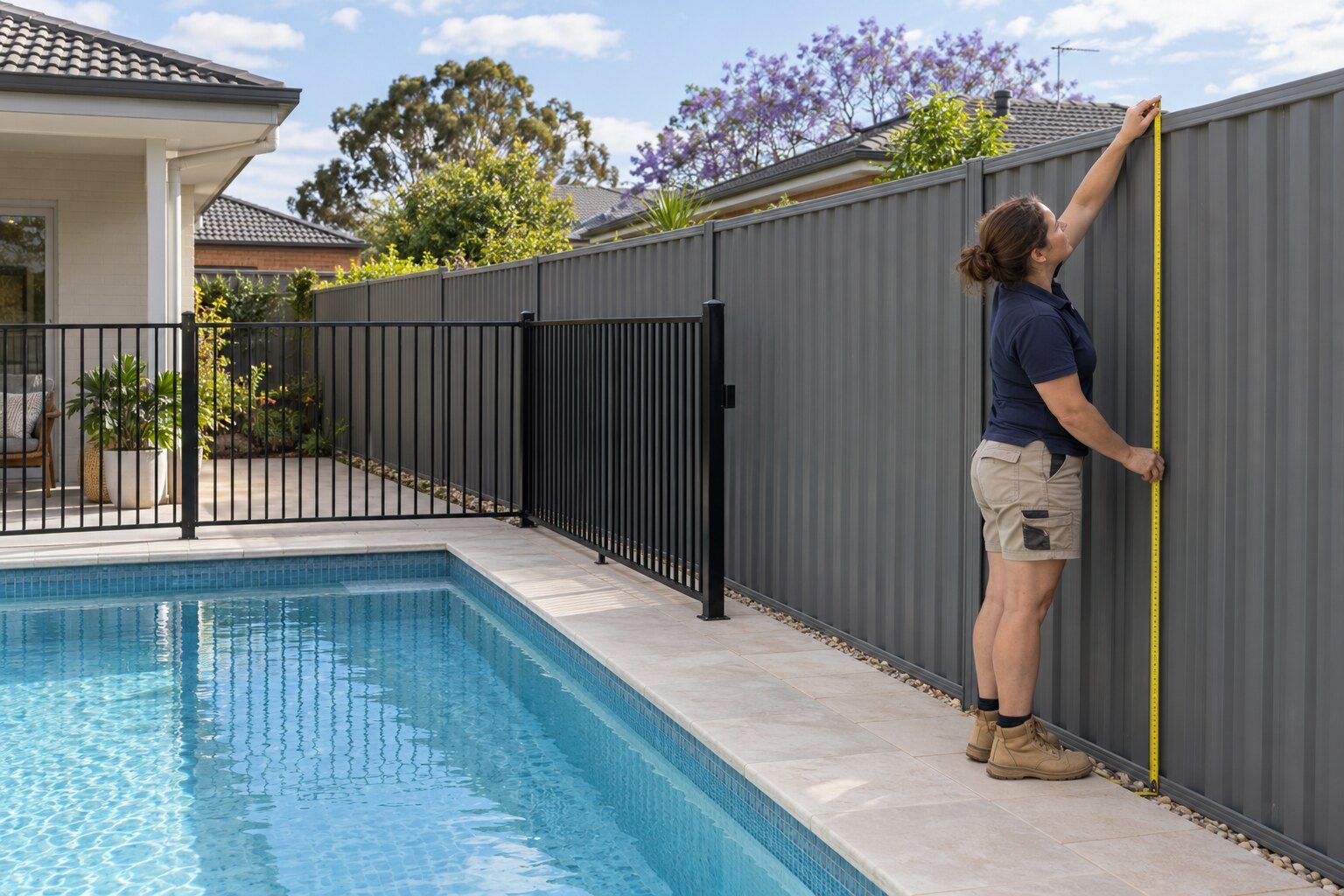
Boundary pool fence height: 1.8 m from the pool side
The NSW Government's guide says: "If a boundary fence is part of the pool fence, the barrier must be 1.8m high." The NSW Swimming Pool Register checklists for pools built from 1 September 2008 add where to measure: "at least 1800mm high measured from the inside of the pool area".
So the height on your neighbour's side doesn't settle it. If your ground is higher, or a garden bed, step or retaining wall sits against the fence on your side, the fence can fall short.
The register's checklist for pools built before 1 September 2008 gives 1200 mm for a boundary fence, and Bayside Council notes the height "may vary for older pools" that have kept to an older standard. If your pool is older, ask the certifier which standard applies. The pool fence height guide covers the other measurements.
The non-climbable zone and your neighbour's side
Bayside Council puts the non-climbable zone for a boundary barrier on the pool side. It says the zone "is located on the inside (pool side) and extends 900mm from the top and outwards from the barrier", and that landscaping, decks, retaining walls, steps, lighting and furniture must not intrude into it. Penrith City Council also puts the 1800 mm measurement inside the pool area.
For a 1.8 m boundary barrier, we found no NSW rule that makes your neighbour's side part of the non-climbable zone. What matters is the pool side: keep plants, pots, furniture and anything else climbable clear of the top 900 mm, and keep the gap under the fence to no more than 10 cm. On an older pool with a lower boundary fence, the outside can matter too, so ask the certifier.
Ask the certifier about your fence
Councils word the boundary rules differently, and the standard depends on your pool's age. The certifier who inspects the barrier decides whether your boundary fence passes.
Who pays for a boundary pool fence: section 33
Section 33 of the Swimming Pools Act deals with this directly. The cost of building, altering, repairing, replacing or maintaining a dividing fence is borne by the owner of the property with the pool, "to the extent to which they are attributable to work done for the purpose of complying with the requirements of this Act". If both properties have pools, those costs are shared "in appropriate proportions". Section 33 overrides the Dividing Fences Act where the two conflict.
So the pool owner pays the extra needed to make the fence a compliant pool barrier, such as raising it to 1.8 m on the pool side. It doesn't make the pool owner pay for the whole fence. The State Library of NSW's guide to neighbour law puts it the same way: the "extra expenses" fall on the owner of the property with the pool.
Sharing the rest of the cost: the Dividing Fences Act
For everything else, the Dividing Fences Act 1991 applies. Neighbours share equally the cost of a "sufficient dividing fence" (section 7). What counts as sufficient depends on the existing fence, how both properties are used, privacy, the kind of fence usual in the area and any council policy (section 4). A neighbour who wants a higher standard than that pays the difference.
- Talk to your neighbour first, with a quote that shows the work.
- Serve a written fencing notice. Section 11 says it must give the boundary line, the type of work and its estimated cost, and it can propose a different split, such as the pool owner paying the pool-compliance part.
- Wait. Your neighbour doesn't have to contribute to work done before a notice is served or before you agree, except urgent repairs.
- If you haven't agreed a month after the notice, either of you can apply to the NSW Civil and Administrative Tribunal (NCAT) or the Local Court for a fencing order.
NCAT's dividing fences page says to serve the fencing notice at least 1 month before applying and to attach it. Legal Aid NSW publishes a guide to fencing notices.
Raising a boundary fence: the 1.8 m approval limit
The NSW Planning Portal says side and rear boundary fences in residential zones can be built without council approval if they're no higher than 1.8 m, or 1.2 m for masonry, among other conditions. On bushfire-prone land the fence must be non-combustible or hardwood, and land on the State Heritage Register or under an interim heritage order is excluded.
That 1.8 m limit and the 1.8 m pool rule can pull against each other. Where the ground is higher on one side, a fence that measures 1.8 m on the pool side can measure more than 1.8 m on the other. Check with your council before raising a boundary fence above 1.8 m.
A separate pool fence inside the boundary
Instead of raising the boundary fence, you can build a pool fence inside it. The boundary fence is then no longer part of the pool barrier, so the 1.8 m rule for boundary fences doesn't apply to it, and the new fence follows the ordinary pool fence rules: at least 1.2 m high, no gap over 10 cm and a clear non-climbable zone.
This can suit a sloping boundary, a fence in poor repair that the neighbour won't replace, or a fence covered in plants. It does take space from the yard.
Boundary fence costs in Sydney
Boundary fence prices in Sydney
| Fence | Published price | Who publishes it |
|---|---|---|
| Colorbond fence, 1.8 m, low / typical / high | $80 / $130 / $190 per metre, incl. GST | What's The Damage, Sydney, October 2026 |
| Colorbond fence, 2.1 m, low / typical / high | $120 / $160 / $250 per metre, incl. GST | What's The Damage, Sydney, October 2026 |
| Timber paling fence, low / typical / high | $80 / $110 / $190 per metre, incl. GST | What's The Damage, Sydney, October 2026 |
| Old fence removal, low / typical / high | $15 / $30 / $50 per metre, incl. GST | What's The Damage, Sydney, October 2026 |
What's The Damage, Sydney fencing cost guide, low / typical / high, installed per metre, prices include GST, updated October 2026, checked 22 October 2026. A cost guide, not a contractor's quote. No Sydney fencing contractor was found publishing a price for raising a fence or converting one into a pool barrier.
The pool fence repair cost guide has prices for pool fencing, gates and repairs.
Common questions
Who pays for a pool fence on the boundary in NSW?
The pool owner pays the cost of the work needed to make the dividing fence comply with the pool rules (Swimming Pools Act section 33). The rest of the cost of an ordinary dividing fence is normally shared equally with the neighbour under the Dividing Fences Act.
How high does a boundary fence need to be for a pool in NSW?
1.8 m, measured from inside the pool area, for pools built from 1 September 2008. The register checklist for older pools gives 1200 mm, so ask the certifier which standard applies to yours.
Where is the non-climbable zone on a boundary pool fence?
On the pool side, for a 1.8 m boundary barrier. Bayside Council says it extends 900 mm from the top and out from the fence on the pool side. On an older pool with a lower boundary fence, ask the certifier how your fence will be assessed.
Does my neighbour have to pay half of a new boundary fence?
For a sufficient dividing fence, neighbours usually share the cost equally under the Dividing Fences Act, after a written fencing notice. The extra cost of making it a pool barrier falls on the pool owner.
What if my neighbour won't agree to the fence work?
Serve a written fencing notice. If you haven't agreed a month later, either of you can apply to NCAT or the Local Court for a fencing order.
Do I need council approval to raise a boundary fence for my pool?
Side and rear fences up to 1.8 m (1.2 m for masonry) are usually exempt in residential zones. A taller fence, or one on land on the State Heritage Register, may need approval, so check with your council.
Where this information comes from
The prices, rules and advice on this page come from these published pages, checked on 22 October 2026.
- Swimming Pools Act 1992 (NSW) · The Act: barrier duties, inspections, certificates, council directions and dividing fence costs (current version from 14 August 2026, checked 23 October 2026)
- Dividing Fences Act 1991 (NSW) · Sharing the cost of a dividing fence, fencing notices and disputes (read 22 October 2026)
- NSW Government: Owning a pool or spa, your obligations · Building Commission NSW guide to barriers, registration, sale and lease certificates and CPR signs (updated 16 March 2026)
- NSW Swimming Pool Register self-assessment checklist (pools built after 1 May 2013) · Register checklist rehosted by Oberon Council, undated
- Bayside Council: Swimming pool and fencing installation info sheet · Council info sheet on boundary barriers and the non-climbable zone (2018)
- Penrith City Council: Swimming pool safety factsheet · Council factsheet on boundary fence height and the non-climbable zone (March 2023)
- State Library of NSW: Neighbours and the law, fences · Guide to dividing fence law, including swimming pool fences
- NCAT: Dividing fences · Tribunal page on fencing notices and applications (updated 19 June 2026)
- Legal Aid NSW: Fences, your rights and obligations · Guide to sharing fence costs and fencing notices
- NSW Planning Portal: Fences, exempt development · Fence heights that can be built without approval (updated 20 June 2023)
- What's The Damage: Fencing cost Sydney · Sydney fencing cost guide, prices including GST, verified October 2026