
The short answer
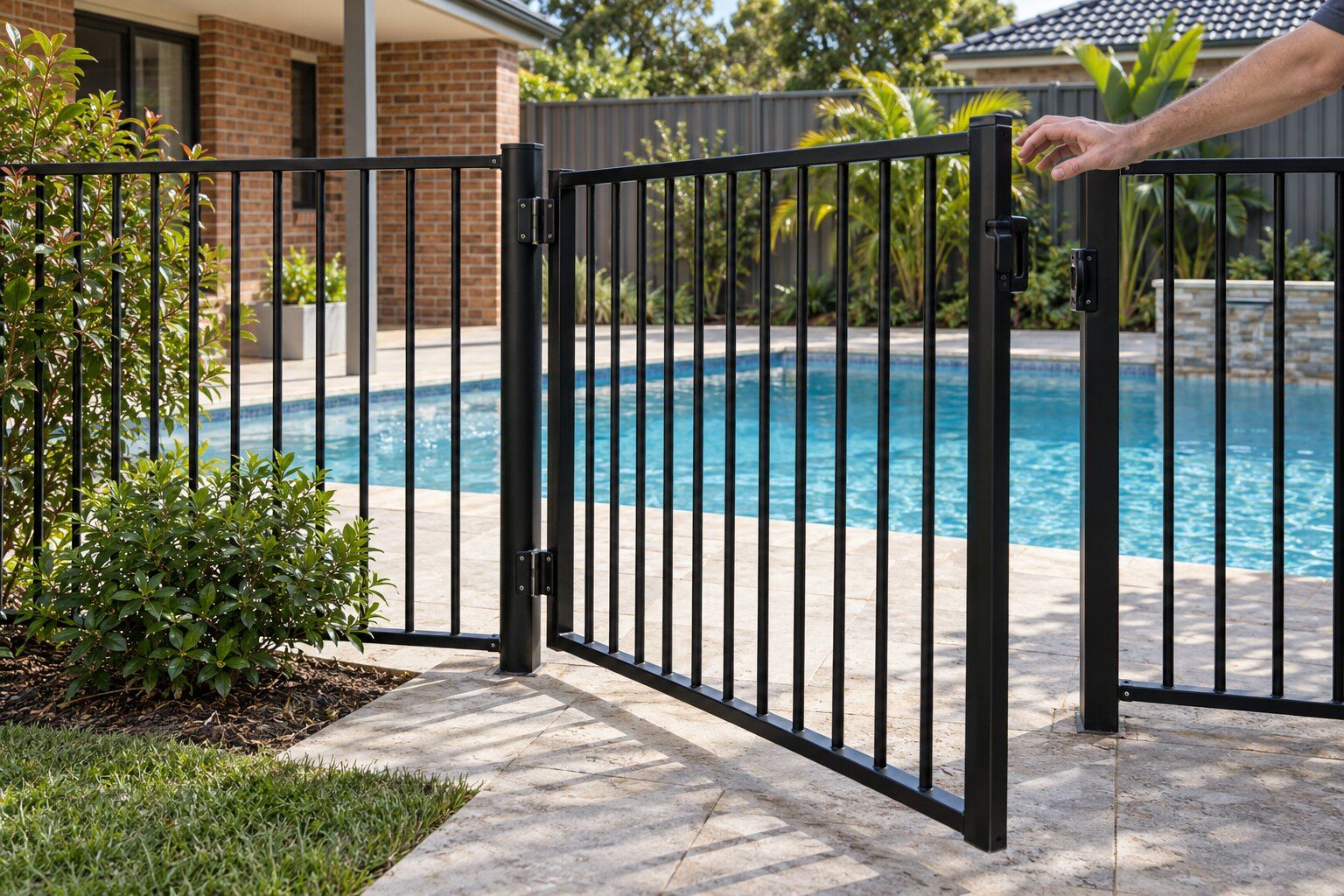
In NSW a pool gate must open outwards, away from the pool, shut by itself from any open position without being pushed, latch by itself when it closes, and never be propped open. The NSW Swimming Pool Register checklists put the latch release at 1500 mm above the ground, or on the inside of the gate behind a shield. A gate that stops closing usually has hinges that have lost tension or need adjusting, a latch out of line, or something in its way. Follow your hinge maker's instructions to adjust it, and call a contractor if that doesn't fix it.
NSW pool gate rules
The NSW Government's guide for pool owners has a gate checklist. It says to check that the gate:
- "is never propped open and is always kept shut"
- "swings outwards (away from the pool area)"
- "shuts automatically from any open position, without having to forcibly close it"
- "automatically locks (self-latches) when it closes"
The law behind it is the Swimming Pools Act 1992: section 16 says gates giving access to the pool must be "kept securely closed at all times when they are not in actual use", and section 15 says the barrier must be kept in a good state of repair.
Pool gate latch height in NSW
The NSW Swimming Pool Register's self-assessment checklists, which councils still publish, give two options for the latch release:
- On the outside: "The release for the gate latch must be 1500mm above ground level"
- On the inside: the release is on the pool side of the gate behind a 450 mm shield, reached over the fence or through an access point 1200 mm above the ground, with the latch at least 150 mm below the top of the fence or shield
Councils describe the inside option in slightly different words, and the full detail sits in the Australian Standard for your pool's age. The checklists date from 2013, so treat them as a guide: the certifier decides whether your latch passes.
Measure from the ground the gate sits on, not from a step or a raised garden bed. Anything a child could stand on near the gate also matters, because it sits in the non-climbable zone.
How to test your pool gate
The register checklists say the gate "must be self closing and latch by itself from any position" and, once closed, "can't be pulled open". Our way of checking that at home:
- Open the gate as far as it goes and let go without pushing it. It should swing shut and latch.
- Open it halfway and let go. Then open it just off the latch, about a hand's width, and let go. It should latch both times.
- Pull and push the closed gate. It shouldn't open without the latch being released.
- Look underneath and around it. Nothing should catch the gate or hold it open, and the gap under it shouldn't be more than 10 cm.
Cessnock City Council's pool checklist adds a test for a child bouncing on the bottom rail: the latched gate shouldn't open. It also links each failure to a fix: if the gate doesn't swing back, replace the hinges; if it swings back but doesn't latch and stay closed, replace the latch; if it can be pulled open once latched, fix or replace the latch.
Test it after wet weather and after anyone works near the fence. A gate that worked last month can stop latching once a post moves or a hinge loses tension.
Why a pool gate won't close or latch
The hinges have lost tension
Spring hinges weaken with time, and a gate that swings slowly or stops short of the latch usually needs more tension. Hinge makers say both hinges must have equal tension.
The latch is out of line
If the gate swings shut but bounces off the latch, the latch or the gate has moved. A sagging gate, loose screws or a shifted post all change the line.
Something is in the way
Sand, leaves, a raised paver, a garden edge or a pool toy can stop the gate in its last few centimetres.
A glass gate has dropped
Glass gates hang on hinges clamped to the glass. A gate that has dropped or shifted no longer lines up with the latch, and Polaris, a glass hinge maker, says to tighten the hinge fixing screws every 6 months.
How to adjust pool gate hinges and latches
These steps come from the manufacturers' published instructions, not from NSW law. Hinges and latches vary, so check the brand and model on yours and follow its instructions.
TruClose self-closing hinges (D&D Technologies)
D&D's Australian FAQ says to increase tension on newer TruClose hinges, insert a flat-head screwdriver into the slotted adjustment dial, push down as far as it goes and turn it a quarter turn anticlockwise, then let the dial rise. That adds one setting. Do it equally on both hinges; D&D says one adjustment is usually enough. On older hinges, remove the small screw and black dust cap on top first. D&D's installation instructions for TruClose TCA and TCHD hinges (2011, hosted by a dealer) add: support a gate heavier than 15 kg while adjusting, never take the hinges apart, never remove the hinges from the gate until the spring tension is released, and use only powdered graphite, never petroleum-based lubricants.
Soft-close glass gate hinges (Polaris)
The Polaris care guide says to tighten the fixing screws every 6 months, but not the speed adjustment cap, and to fine-tune the cap to get the closing speed you want. It suggests checking gates near the coast every 2 to 4 weeks.
MagnaLatch latches (D&D Technologies)
For the MagnaLatch Top Pull with panic bar, D&D's May 2026 instructions say to loosen the striker pin's grub screw with a 2.5 mm Allen key, wind the pin out until it engages the latch, then tighten the grub screw. They give an ideal gate gap of 19 mm, within a range of 11 to 24 mm, for that model.
Lubricant: check the hinge maker's instructions first
The NSW Government's checklist suggests spraying hinges and latches with lubricating oil or silicone, but D&D's instructions say to use only powdered graphite on TruClose hinges. Use whatever your hinge maker specifies.
When a pool gate needs a contractor
Call a fencing or glass contractor if the gate still won't close after adjusting, a hinge or latch is broken or rusted, the gate opens the wrong way, the latch is too low, or a post or glass panel has moved. Re-hanging a gate, replacing hinges and moving a latch are routine fencing jobs.
Residential fencing work over $5,000 including GST needs a contractor licence. The pool fence repair cost guide has published gate repair prices. After a failed inspection, keep the certifier's list and book the re-inspection once the gate works. The failed pool inspection guide explains the timeline.
Common questions
Why won't my pool gate close by itself?
Usually the self-closing hinges have lost tension or have unequal tension, or something is catching the gate. Check the hinge maker's instructions for adjusting tension, clear anything in the gate's path, and call a contractor if the hinges are worn or broken.
How high does a pool gate latch need to be in NSW?
The NSW Swimming Pool Register checklists say the latch release must be 1500 mm above ground level, or on the inside of the gate behind a 450 mm shield with the latch at least 150 mm below the top. A certifier decides whether a particular latch passes.
How do I adjust self-closing pool gate hinges?
It depends on the hinge. For D&D TruClose hinges, D&D says to push down the slotted adjustment dial with a flat-head screwdriver and turn it a quarter turn anticlockwise, then repeat equally on the other hinge. Follow the instructions for the brand and model fitted.
Which way should a pool gate open in NSW?
Outwards, away from the pool area. A gate that swings into the pool area has to be re-hung.
Can I prop the pool gate open while we're in the pool?
No. The Swimming Pools Act requires gates to be kept securely closed whenever they're not in actual use, and the NSW Government says the gate should never be propped open.
Does a pool gate need to latch from halfway open?
Yes. The rule is that it shuts and latches by itself from any open position: fully open, halfway or just ajar.
Where this information comes from
The prices, rules and advice on this page come from these published pages, checked on 22 October 2026.
- NSW Government: Owning a pool or spa, your obligations · Building Commission NSW guide to barriers, registration, sale and lease certificates and CPR signs (updated 16 March 2026)
- Swimming Pools Act 1992 (NSW) · The Act: barrier duties, inspections, certificates, council directions and dividing fence costs (current version from 14 August 2026, checked 23 October 2026)
- NSW Swimming Pool Register self-assessment checklist (pools built after 1 May 2013) · Register checklist rehosted by Oberon Council, undated
- Cessnock City Council: Swimming pool generic checklist · Hunter council's owner checklist linking each gate test to a fix (November 2024)
- D&D Technologies Australia: Frequently asked questions · Hinge maker's guidance on adjusting TruClose hinge tension
- D&D Technologies: TruClose TCA and TCHD hinge installation instructions · Hinge maker's installation and adjustment instructions (December 2011), hosted by a dealer
- Polaris Soft Close Hinge: Care guide and checklist · Glass gate hinge maker's maintenance guide (August 2022)
- D&D Technologies: MagnaLatch Top Pull with panic bar instructions · Latch maker's Australian installation instructions (May 2026), hosted by a distributor
- NSW Government: Fencing work licences · When residential fencing work needs a contractor licence