Which certificate do you need?
NSW has three documents that can go with a sale or lease of a home with a pool. Which one works depends on whether you're selling or leasing, and how recently the pool was built.
Pool certificates in NSW
| Document | Who issues it | Selling | Leasing |
|---|---|---|---|
| Certificate of compliance | Council or registered certifier | Yes | Yes |
| Occupation certificate issued in the last 3 years | The certifier for the building work | Yes | Yes |
| Certificate of non-compliance | Council or registered certifier | Yes, buyer fixes within 90 days of settlement | No |
From the NSW Government's Owning a pool or spa page (updated 16 March 2026). A sale also needs the pool's Swimming Pool Register certificate.
A lot in a strata or community scheme with more than 2 lots doesn't need a pool certificate for a sale or lease. The owners corporation is responsible for the common pool, and the council inspects those pools every 3 years.
How to get a certificate of compliance
- Check the pool is registered. A certificate can't be issued for an unregistered pool. Look it up or register online on the NSW Swimming Pool Register, which moved to address-based registration on 16 March 2026.
- Do a quick pre-check. Clear anything climbable away from the fence, test the gate from every open position and check the CPR sign. The pool barrier checker walks you through it.
- Book the inspection. Use your council or a private registered certifier. Give them the date you need the certificate by.
- Fix anything listed. If the pool fails, you get a written list of defects. You choose who does the work: a licensed fencing contractor or a handyman, then book the re-inspection.
- Re-inspection and certificate. Once everything passes, the certificate is issued. Keep a copy with your property records.

What the certifier checks
The barrier is checked against the Australian Standard that applies to when your pool was built. Expect them to look at:
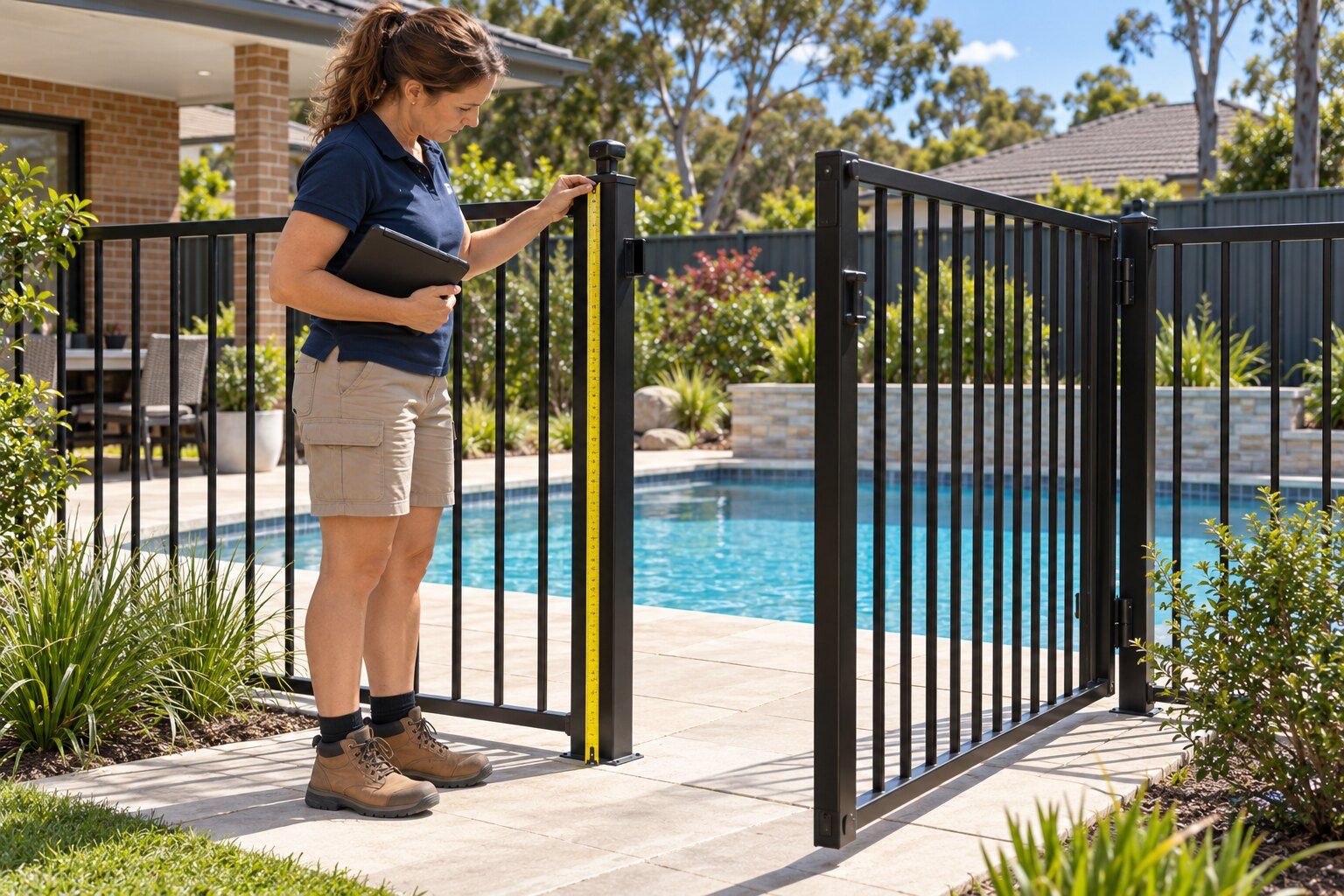
- Fence height of at least 1.2 m, and 1.8 m where a boundary fence forms part of the barrier
- Gaps under the fence and between bars of no more than 10 cm
- Nothing climbable within 90 cm outside the top of the fence, or 30 cm inside
- Gates that open outwards, self-close and latch from any open position
- Doors and windows that open into the pool area
- A CPR sign in good condition, readable from 3 m
The NSW pool fence rules guide goes through each one, and the compliance checklist turns them into a walk-around.
What it costs
Council fees are set under the Swimming Pools Regulation 2018: Waverley Council publishes $150 for the first inspection and $100 for a re-inspection. Northern Beaches and Sutherland Shire charge a $250 application fee, and Northern Beaches refunds $100 if no re-inspection is needed. Private certifiers set their own prices: The Pool Certifier Guy publishes $295 including GST (page modified 14 August 2026) and Pool Certification Sydney publishes $450 plus GST for an inspection, with re-inspections extra. The pool inspection cost guide lists every published figure.
Leave enough time
If the pool fails, you'll need time for repairs and a re-inspection. For a lease, the certificate has to be ready before the tenancy starts, because a certificate of non-compliance can't be used to rent a property.
Common questions
What is a pool compliance certificate?
A certificate of compliance is issued under the Swimming Pools Act 1992 after a council or registered certifier inspects your pool barrier and finds it meets the rules. It's what most people mean by a pool safety certificate in NSW.
How long is a pool compliance certificate valid for?
Three years from the date it's issued. It stops being valid if the council issues a direction about the pool in that time.
Who issues a pool compliance certificate?
Your local council or a certifier registered with the NSW Building Commission to inspect swimming pools. Check a certifier on the Building Certifiers Public Register.
Do I need a pool compliance certificate to sell my house?
The contract needs a Register certificate plus one of: a certificate of compliance, an occupation certificate issued in the last 3 years, or a certificate of non-compliance. Without them, the buyer can rescind within 14 days of exchange unless settlement has already happened.
Can I get a certificate if my pool isn't registered?
No. The pool must be registered on the NSW Swimming Pool Register before a certificate of compliance can be issued. Registering online is free. See the Swimming Pool Register guide.
What does a certificate of compliance cost?
Council fees are set under the Swimming Pools Regulation 2018: Waverley and Woollahra publish $150 for the first inspection and $100 for a re-inspection. Among Sydney certifiers, The Pool Certifier Guy publishes $295 including GST (page modified 14 August 2026) and Pool Certification Sydney publishes $450 plus GST. See the pool inspection cost guide.
Where this information comes from
The rules and prices on this page come from these published pages, checked on 16 October 2026.
- NSW Government: Owning a pool or spa, your obligations · Building Commission NSW guide to barriers, registration, sale and lease certificates and CPR signs (updated 16 March 2026)
- Building Commission NSW: An improved swimming pool register has launched · NSW Government news on the register relaunched on 16 March 2026
- Service NSW: Apply for swimming pool certifier registration · What a registered swimming pool certifier can do
- Waverley Council: Pool barrier inspection request · Council fees and the Australian Standard that applies by construction date (last updated 30 June 2026)
- The Pool Certifier Guy · Sydney pool certifier, published prices including GST (page modified 14 August 2026)
- Pool Certification Sydney: Fees · Sydney pool certifier, published fees plus GST (undated)
Related guides
- NSW Swimming Pool RegisterWho has to register, the 16 March 2026 relaunch, free online registration or a council fee, and why registration doesn't mean the pool complies.
- Pool compliance checklist for NSWWalk your barrier before the certifier does: fence, gaps, gates, latches, the non-climbable zone, doors and windows, the CPR sign and the paperwork.