The short answer
In NSW a pool or spa needs a child-resistant barrier at least 1.2 m high, measured from finished ground level, with no gap over 10 cm under it or between its bars. Nothing climbable may sit within the 90 cm non-climbable zone, or within 30 cm inside the pool area. Gates must open away from the pool and close and latch by themselves. Where a boundary fence forms part of the barrier, it must be 1.8 m high. The pool must be on the NSW Swimming Pool Register, and a sale or lease needs a certificate. Which Australian Standard your barrier is measured against depends on when the pool was built, so a registered certifier has the final say.
Who the NSW pool fence rules apply to
The rules come from the Swimming Pools Act 1992 and the Swimming Pools Regulation 2018. According to the NSW Government's guide for pool owners (updated 16 March 2026), they cover pools and spas on a site with a home, a movable dwelling, or tourist and visitor accommodation.
That includes more than in-ground pools. Portable and inflatable pools that can be filled to a depth of 300 mm or more fall under the barrier rules, and so do spas. A spa can sometimes use a lockable lid instead of a fence; the spa and inflatable pool guide covers when.
You, as the owner, are responsible for keeping the barrier compliant. In a strata or community scheme, the owners corporation or body corporate is responsible for a pool on common property.
NSW pool fence requirements at a glance
These are the measurements a certifier checks first. They come from the NSW Government's guide, with the gate latch height and the 1.8 m measuring point taken from the NSW Swimming Pool Register's self-assessment checklist for pools built after 1 May 2013.
Pool barrier measurements in NSW
| Part of the barrier | Requirement |
|---|---|
| Fence height | At least 1.2 m, measured from finished ground level |
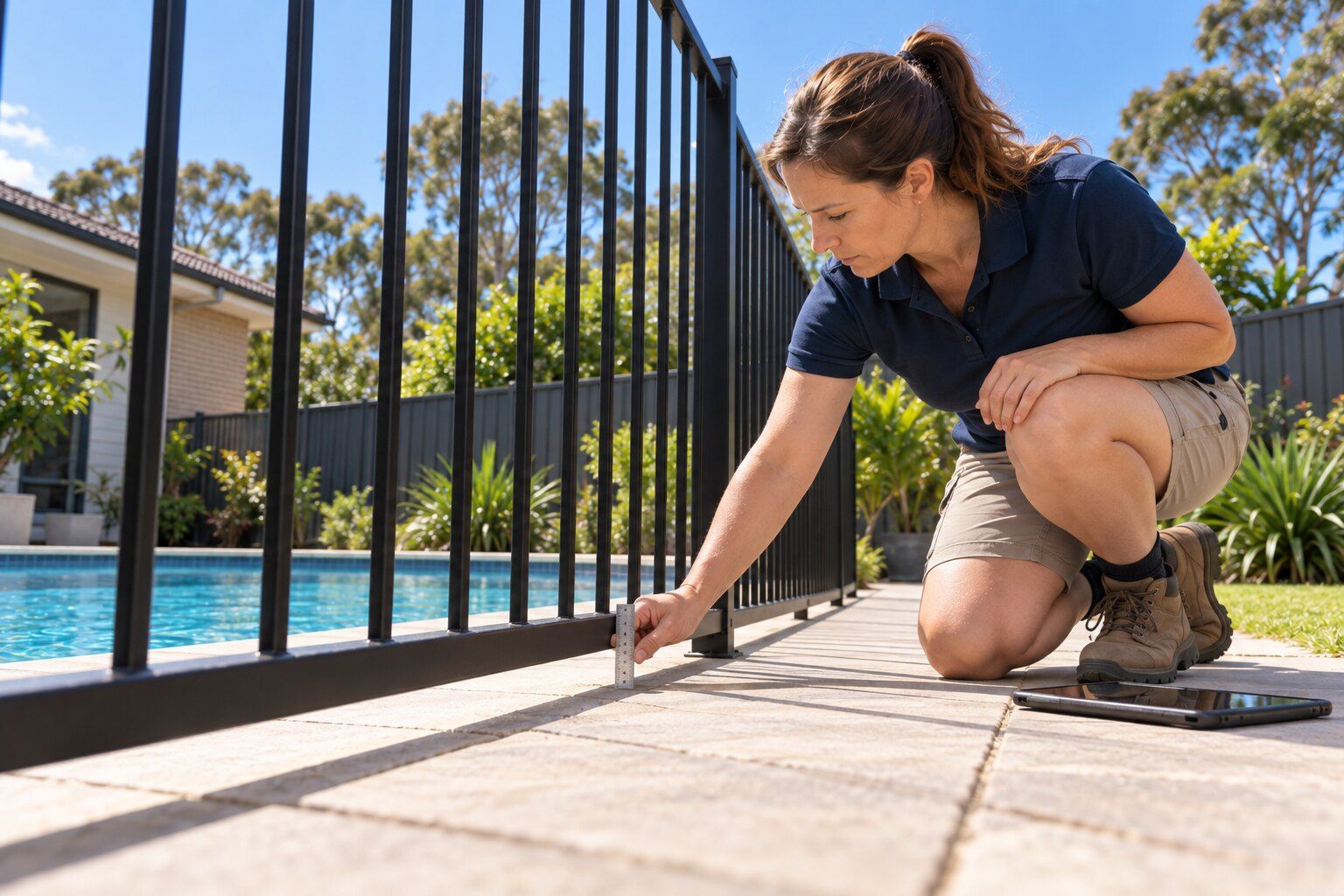
| Gap under the fence | No more than 10 cm from finished ground level |
| Gaps between vertical bars | No more than 10 cm |
| Horizontal bars a child could climb | At least 90 cm apart |
| Mesh or perforated panels | Holes no more than 13 mm |
| Non-climbable zone | Nothing climbable within 90 cm of the top of the fence, plus the 30 cm inside the pool area |
| Boundary fence used as the pool fence | At least 1.8 m, measured from inside the pool area |
| Gate latch release | 1500 mm above ground under the register checklist for pools built after 1 May 2013. The standard allows some other arrangements, so a certifier decides. |
| CPR sign | In good condition and easily readable from 3 m |
Sources: NSW Government, Owning a pool or spa (updated 16 March 2026); NSW Swimming Pool Register self-assessment checklist for pools built after 1 May 2013 (undated, rehosted by Oberon Council). Checked 16 October 2026.
The non-climbable zone catches more pools than the fence itself. Pot plants, barbecues, chairs, eskies, tree branches and retaining walls all count if a child could use them as a hand hold or foot hold within 90 cm of the top of the fence. The pool fence height guide explains how to measure the heights, gaps and zones yourself.
Pool gate regulations in NSW
A pool gate has to swing outward, away from the pool. It must close by itself and latch by itself from any open position, and it must never be propped open. A worn hinge that stops the gate swinging fully shut, or a latch that has dropped out of line, is enough for a gate to fail this test.
On latch height, the register checklist for pools built after 1 May 2013 says the latch release must be 1500 mm above ground level. The Australian Standard also allows some other arrangements, including a lower latch in some cases, so a certifier decides whether a particular gate passes.
Doors and windows that open onto the pool
The NSW Government's guide says older pools might include doors or windows as part of the barrier, and that "this is no longer allowed". Some council guides still describe other arrangements for older pools and for very small, very large or waterfront properties. Older pools may have been assessed differently, so if a door or window from your home opens into the pool area, ask a registered certifier how your pool will be assessed before you change anything.
Which Australian Standard applies to your pool
Your barrier is measured against the version of AS 1926 that applied when the pool was built. Councils publish the bands below. They don't agree on exactly where the first band ends, so check with the certifier if your pool was built around August 2008.
Australian Standard by pool construction date
| When the pool was built | Standard | Note |
|---|---|---|
| Up to about August 2008 | AS 1926-1986 | Waverley Council lists 1 August 1990 to 31 August 2008. Wagga Wagga City Council says before 30 August 2008. |
| 1 September 2008 to 30 April 2013 | AS 1926.1-2007 | The same on both councils' pages |
| From 1 May 2013 | AS 1926.1-2012 | Also applied when an older barrier is altered |
Sources: Waverley Council inspection request form (updated 30 June 2026); Wagga Wagga City Council pool legislation page (undated); NSW Government, Owning a pool or spa (updated 16 March 2026). Ask the certifier which standard they will apply.
If you alter the barrier, the NSW Government's guide says AS 1926.1-2012 is applied and previous exemptions cease. Replacing a section of fence or moving a gate can therefore bring the whole barrier under the current standard. Ask a certifier before you start, not after.
Pools built using a performance solution must be inspected by a certifier with the appropriate registration.
Registration, inspections and certificates
- Registration. Every pool and spa must be on the NSW Swimming Pool Register. Online registration is free. Registration doesn't show the pool complies. See the NSW Swimming Pool Register guide.
- Certificate of compliance. Issued by your council or a registered certifier after an inspection, and valid for 3 years.
- Selling. The contract needs the register certificate plus a valid certificate of compliance, an occupation certificate from the last 3 years, or a certificate of non-compliance.
- Leasing. The tenant must get a certificate of compliance or an occupation certificate. A certificate of non-compliance can't be used to rent a property.
- Council inspections. Councils inspect pools at tourist and visitor accommodation and movable dwellings every 3 years. Sydney councils such as Penrith and Ku-ring-gai also include premises with more than two dwellings.
Lots in strata or community schemes with more than 2 lots are exempt from the sale and lease certificate rules, and so are off-the-plan sales. The selling or leasing guide sets out the timing.
When the barrier doesn't comply
A certifier who finds problems gives you a list of what has to be fixed. You choose who fixes them. Fixes can be small: a gate hinge adjusted, a latch moved, a gap under the fence filled, or a pot plant moved out of the non-climbable zone.
Bigger fence work over $5,000, including labour, materials and GST, needs a tradesperson with a contractor licence. Check the licence on Service NSW before you sign. The pool fence repair cost guide has published Sydney prices.
Check before you rely on a checklist
The figures above are the common ones. Your pool's age, a spa, a boundary fence or a door into the pool area can change what applies. The assessment that counts is the one a registered certifier or your council makes on site.
Common questions
How high does a pool fence have to be in NSW?
At least 1.2 m, measured from finished ground level. Where a boundary fence forms part of the pool barrier, it must be 1.8 m high, and the register checklist measures that from inside the pool area.
What is the non-climbable zone on a pool fence?
It's the 90 cm area measured from the top of the fence where nothing a child could use as a hand hold or foot hold may sit. The NSW Government's guide also covers the space extending 30 cm inside the pool area.
How high does a pool gate latch have to be in NSW?
The NSW Swimming Pool Register checklist for pools built after 1 May 2013 says the latch release must be 1500 mm above ground level. The Australian Standard allows some other arrangements, so a registered certifier decides whether your gate passes.
Do the pool fence rules apply to above-ground and inflatable pools?
Yes, if the pool can be filled to 300 mm or more. The NSW Government's guide says portable and inflatable pools that can hold that depth fall under the barrier rules.
Who can issue a pool compliance certificate in NSW?
Your council or a registered certifier, after inspecting the pool. A fencing contractor can repair the barrier but can't issue the certificate. A certificate of compliance is valid for 3 years.
Can I still use a door or window as part of my pool barrier?
The NSW Government's guide says doors and windows forming part of the barrier are no longer allowed. Older pools may have been assessed differently, so ask a registered certifier how your pool will be assessed.
Where this information comes from
The prices, rules and advice on this page come from these published pages, checked on 16 October 2026.
- NSW Government: Owning a pool or spa, your obligations · Building Commission NSW guide to barriers, registration, sale and lease certificates and CPR signs (updated 16 March 2026)
- NSW Swimming Pool Register self-assessment checklist (pools built after 1 May 2013) · Register checklist rehosted by Oberon Council, undated
- Waverley Council: Pool barrier inspection request · Council fees and the Australian Standard that applies by construction date (last updated 30 June 2026)
- Wagga Wagga City Council: Swimming pool legislation · Council summary of the Australian Standard that applies by construction date (undated)
- Service NSW: Check a builder or tradesperson's licence · Public licence check for home building contractors
- NSW Government: Fencing work licences · When residential fencing work needs a contractor licence